Case Study · Robot Offline Programming
AFRIT Side Tipper Bins
Deploying offline robot programming on a 24-axis Yaskawa gantry welding system — cutting programming time by 60% and doubling daily production output.
Deploying offline robot programming on a 24-axis Yaskawa gantry welding system — cutting programming time by 60% and doubling daily production output.
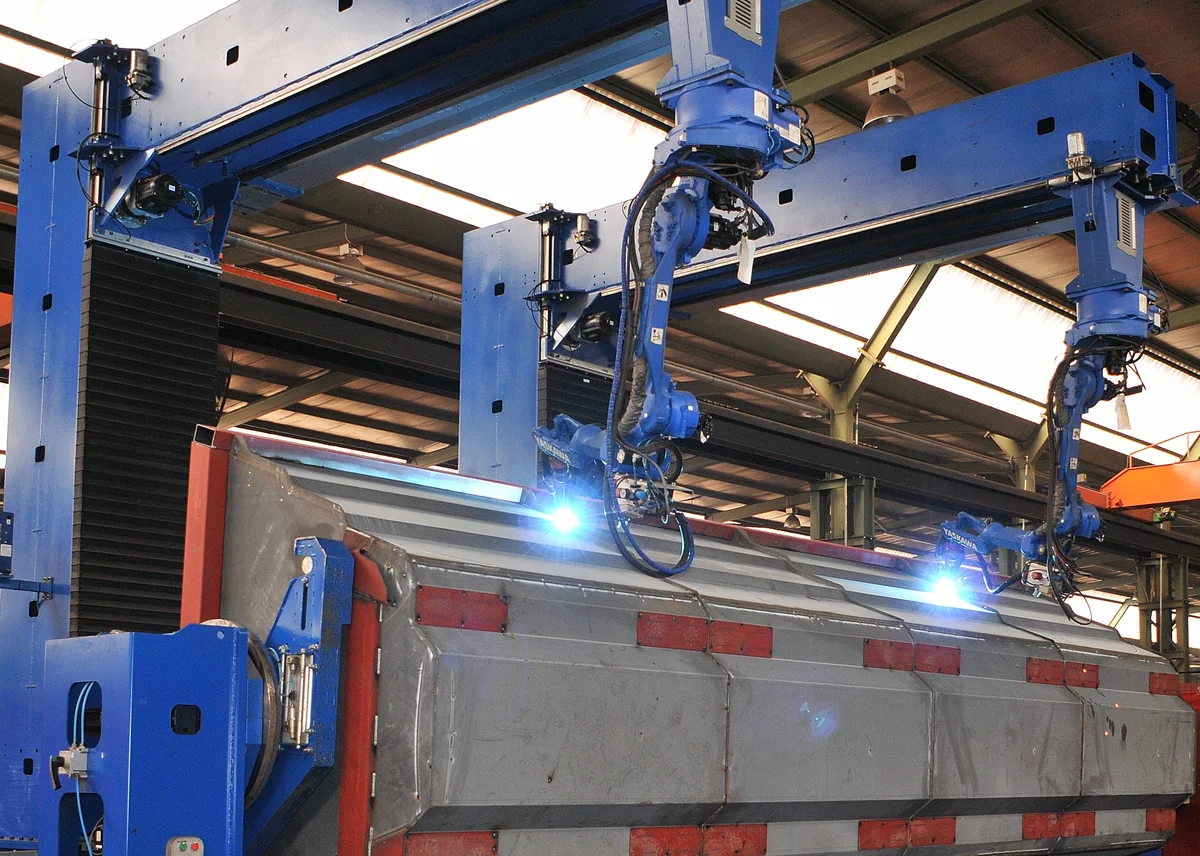
AFRIT — one of Africa's most respected trailer manufacturers, with more than 60 years of manufacturing history — was midway through a five-year modernisation plan at their 78,000m² production facility in Rosslyn, Pretoria. The company had invested in a state-of-the-art 24-axis Yaskawa MOTOMAN gallow gantry welding system to weld large S7 side tipper bins — heavy structural fabrications used to haul bulk commodities like coal, iron ore, and manganese.
The gantry stretched 24 metres in length with support pillars over three metres high, running two MOTOMAN MA2010 robots fitted with seam tracking cameras across Z and Y beam travel paths of up to 3m and 3.5m respectively.
The system was technically capable. But with 25 bin variants to accommodate — each a large structural fabrication with complex multi-pass weld sequences — manual robot teach-in programming was the bottleneck. Every programme change took up to two weeks of manual work at the teach pendant. Engineers spent their time on programming rather than process improvement, production output was capped, and programming errors were generating scrap on complex structural parts.
As Delfoi Robotics' deployment partner, APEXIZ implemented offline robot programming (OLP) for AFRIT using Visual Components Robotics OLP (formerly Delfoi Arc) to accelerate robot programming and eliminate shop-floor teach-in time. APEXIZ was responsible for the complete OLP deployment: building the virtual cell model of AFRIT's 24-axis gantry, calibrating it against the physical system, integrating seam tracking macros, and validating that programmes generated offline could be transferred to the robots and run without manual touch-up.
APEXIZ built an accurate virtual model of AFRIT's full gantry system in the OLP environment — replicating robot geometry, travel axes, tooling configuration, and the spatial relationship between the robots and the bin fixtures. The precision of this model was critical: any deviation between the virtual and physical environments would translate directly to weld misalignment on the shop floor.
Calibration of the physical cell was conducted to align the real system to the virtual model — a process requiring systematic measurement and iterative refinement to achieve the positional accuracy required for consistent arc welding across the full 24-metre travel range.
AFRIT's gantry robots were equipped with seam tracking cameras — a sensor-guided system that allows the robot to adjust its path in real time based on actual weld joint position. Integrating seam tracking with offline-generated programmes requires the correct software macros to be embedded in the programme structure, and for the handshaking between the OLP system and the tracking hardware to be correctly configured.
APEXIZ handled this integration, ensuring the seam tracking macros were correctly implemented and that programmes transferred from the OLP environment retained the functionality needed to activate and respond to the tracking system on the shop floor.
"Delfoi Arc has proven to be a very versatile software — our robot systems have seam tracking functionality, Delfoi was able to implement the macros for the seam tracking. With the assistance of Delfoi Robotics' counterpart APEXIZ the commissioning could be done with great precision."
— Ferdi Beukes, Mechatronic Engineer, AFRIT
The critical test of any OLP deployment is whether programmes can run on the physical robot without manual touch-up. Touch-up corrections after transfer indicate a gap between the virtual and real environments — and on a system producing large structural bins across 25 variants, even small errors compound into significant rework and scrap.
APEXIZ worked systematically through the commissioning process to close this gap, validating that programmes generated in the OLP environment could be transferred and executed on AFRIT's gantry without correction. This zero-touch-up outcome was the defined success criterion for the engagement.
"For us it is very important that the user is confident to copy and run the programs created offline without any touch-up — and we were able to achieve it."
— Hari Nidamarthy, CEO, APEXIZ
The impact was measurable immediately. AFRIT's engineering team, who had managed programme changes measured in weeks, were now operating on a cycle measured in days.
"Our engineers say that manual programming man work hours have been reduced by 80% and programming time reduced by 60%, from two weeks manual to four days offline, and we have increased our output of 8 bins a day to between 16 and 20 bins a day."
— Gerhard van der Walt, Continuous Improvement Manager, AFRIT
The seam tracking integration meant the robots were not simply running pre-set paths — they were adapting to real-world variation in weld joint position. The combination of accurate offline programmes with active seam tracking created a welding system that was both highly consistent and robust to manufacturing variation.
"Since the implementation of Delfoi Robotics (now Visual Components Robotics OLP), our parts are more consistent as well as the repeatability of welding has improved significantly. We have more time improving welding and other systems because of the time saved by not needing to do manual programming and touch ups on the programming."
— Ferdi Beukes, Mechatronic Engineer, AFRIT
The AFRIT project was a technically demanding commissioning engagement on one of the most complex robotic welding configurations in active production in Southern Africa at the time — a 24-axis, 24-metre system running multiple Yaskawa robots across dozens of part variants with real-time seam tracking.
The outcomes achieved — zero touch-up programme transfer, 80% reduction in programming hours, doubling of daily output — were the result of precise calibration, deep platform expertise, and the engineering rigour APEXIZ applied during commissioning. This is the core of what APEXIZ brings to complex OLP deployments: not simply the software, but the execution that makes it deliver measurable results in production.
← Back to References