Case Study · Education & Outreach
Bringing Concepts to Life
A hands-on simulation workshop at Osmania University — where students studying robotics and automation got to see those concepts applied using real industrial tools.
A hands-on simulation workshop at Osmania University — where students studying robotics and automation got to see those concepts applied using real industrial tools.
Mechanical engineering programmes cover robotics, automation, and manufacturing in considerable depth. Students develop conceptual understanding of how robotic systems are designed, how automation workflows are structured, and how manufacturing processes are planned and controlled. That academic grounding is essential — and it naturally raises a question that students begin to ask during their studies: how are these concepts put to work in actual engineering environments?
Simulation platforms, digital twin tools, and robot offline programming software are among the primary answers to that question. They are how engineers in industry design, validate, and optimise the systems that students are studying in theory. The Department of Mechanical Engineering at Osmania University invited APEXIZ to make that connection tangible — as part of Mecharena 2026, the department's annual technical programme.
APEXIZ conducted a hands-on workshop at Osmania University focused on robotic simulation, digital twin concepts, and robot offline programming using Visual Components software. The workshop was designed as a direct complement to what students are studying — taking the systems and principles covered in their curriculum and demonstrating how those same ideas are applied using tools in active industry use.
The workshop was led by APEXIZ engineers Mr. Shiva Prasad and Mr. Akshay Kumar. The format was practical throughout: participants engaged directly with the software, building and running simulations rather than observing a prepared demonstration. The intent was to give students a working experience of the tools, not just an introduction to them.
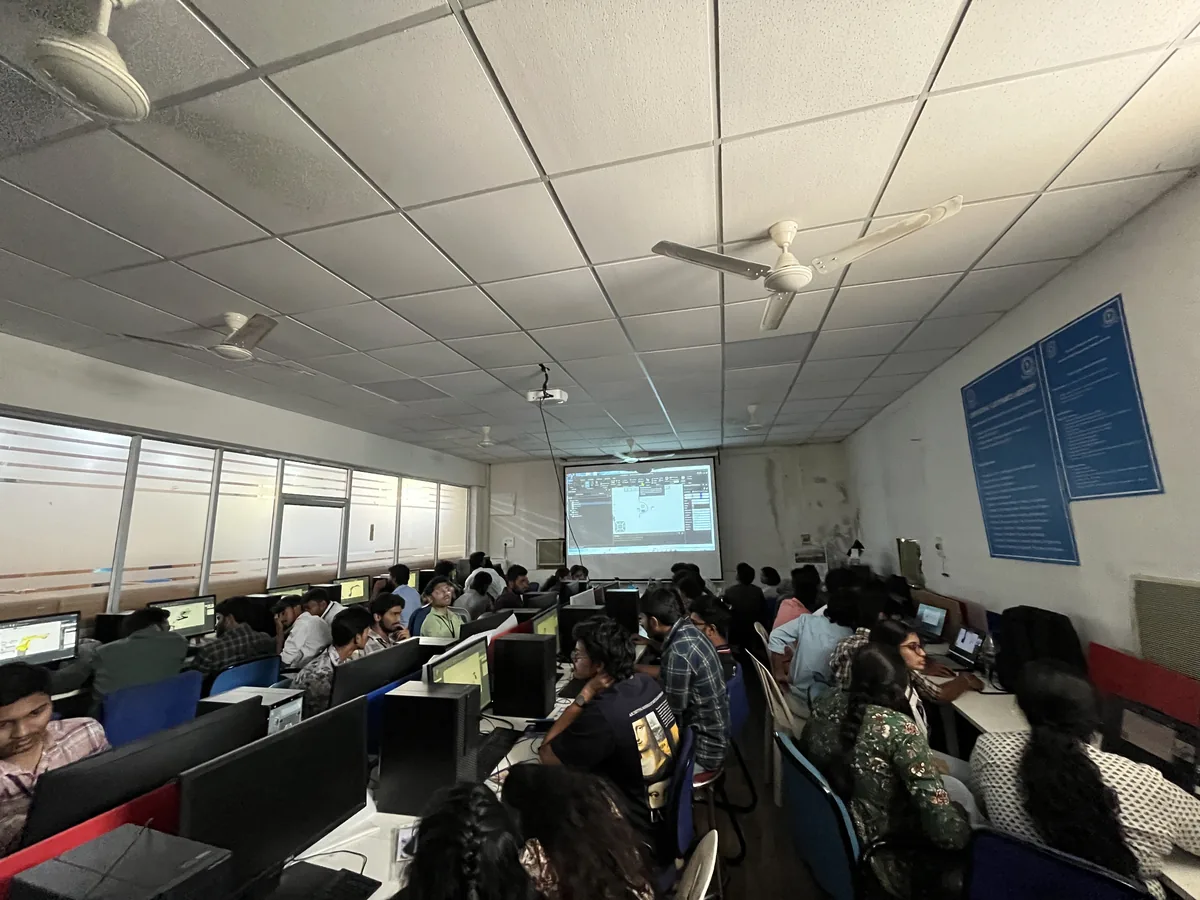
The workshop was planned for around 30 students. Registrations reached 75 before the hall hit capacity and sign-ups were closed. Participants came from multiple academic institutions across the city, reflecting interest that extended well beyond the host department. Working professionals with existing simulation experience also attended.
The workshop was scheduled to end at 5:00 PM. It ran until 6:30 PM, with participants continuing to engage and questions carrying well past the original close. Several students asked directly whether similar workshops could be brought to their own colleges.
"The students remained enthusiastic throughout. The workshop continued until 6:30 PM because of their interest."
— Madhusudan, Associate Professor, Dept. of Mechanical Engineering, Osmania University
"Visual Components integrates physics-based simulation, discrete event simulation, and full factory simulation in one platform — something other tools handle through separate modules."
— Mahomed Yaser, Industry Professional, 4 years in robot simulation
"A 2–3 day workshop would benefit more students. We would want a similar workshop at our college."
— Siri Akshaya, Final Year Student
Students who are actively learning robotics and automation concepts engage quickly when those concepts are applied in a live tool environment. The questions that came up during the workshop were grounded and specific — reflecting the conceptual work students are doing in their programmes. Practical exposure does not replace that academic learning; it accelerates it by giving students a concrete reference point for what they are studying.
The cross-institutional attendance and the presence of working professionals confirmed that this kind of practical exposure has broad relevance. Students from multiple colleges showed up without being formally invited. Professionals with years of field experience found the workshop worth attending. Both groups stayed until the end.
What the Osmania University workshop demonstrated is straightforward: when students who are building conceptual understanding get structured exposure to how those concepts are applied in industry, the response is immediate and sustained. The collaboration between Osmania's Department of Mechanical Engineering and APEXIZ created that space — and the participation it drew reflected genuine interest, not just availability.
APEXIZ is committed to supporting this kind of academic-industry engagement. The interest observed at Osmania — across institutions, across experience levels — points to real scope for extending practical, tool-based learning to more students and more campuses. The foundation is being laid in classrooms across the country. Workshops like this help students see where it leads.
← Back to References